On April 10, 2016, something happened that no one working in direct mail had ever seen -and that no American had seen since July 1919: the USPS lowered its rates.
It didn’t last.
That brief window, where a First-Class stamp dropped from 49¢ to 47¢, now reads like a historical footnote. Since 2022, the USPS has raised rates six times. A Forever stamp that cost 55¢ in 2020 costs 78¢ today -and a 4-cent increase to 82¢ is proposed for July 12, 2026, pending Postal Regulatory Commission approval. That’s a 49% increase in six years, with more explicitly promised.
The 2016 reduction is worth understanding, though -not as nostalgia, but because it explains exactly where the money goes and why it never stays down.
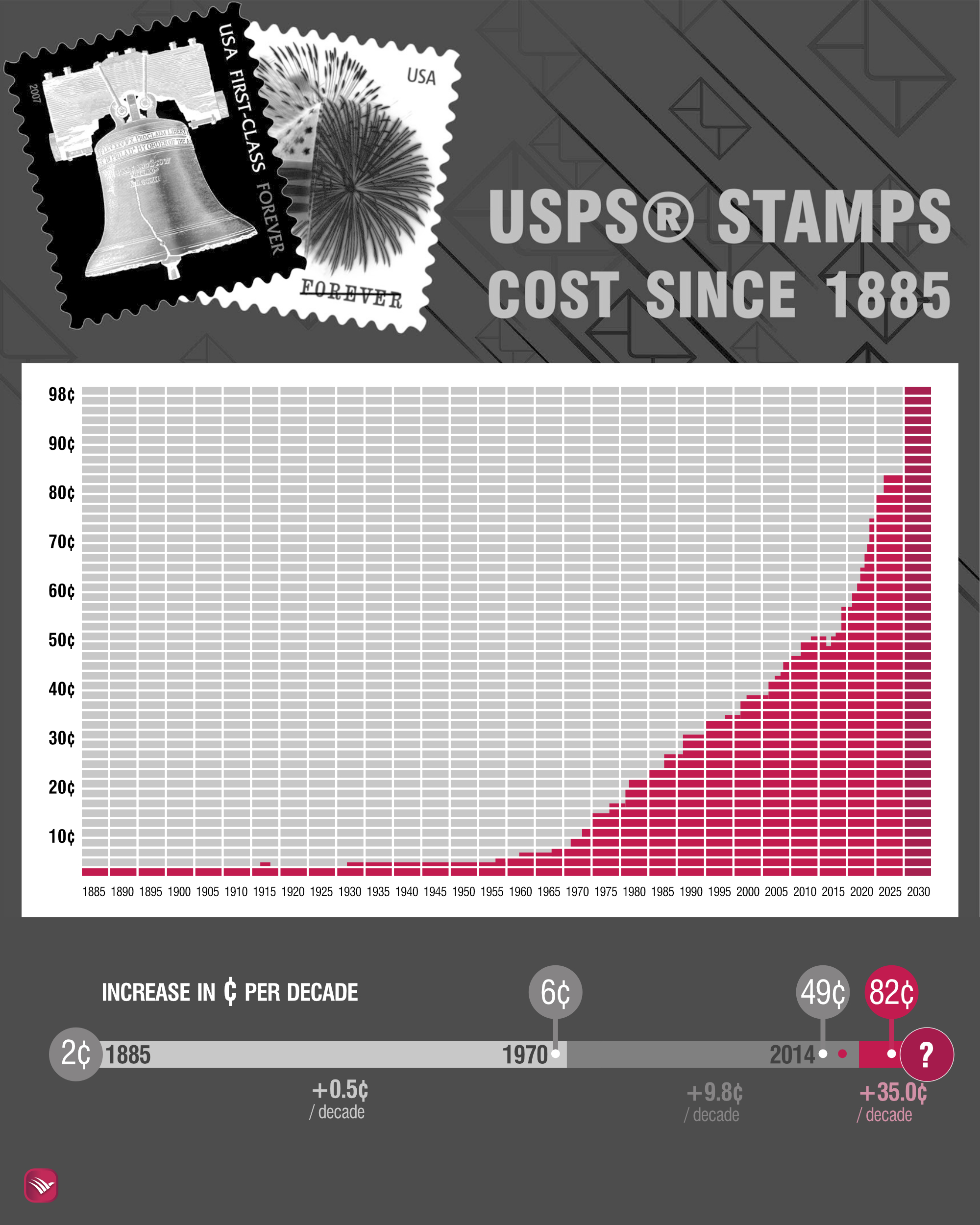
140 Years of One Direction
The United States issued its first postage stamps in 1847. Before that, rates were written by hand on each letter and varied by distance and sheet count. When standardized stamps arrived, a first-class letter cost 3 cents -roughly 50 cents in today’s money, which means the stamp was already priced about where it is now. What’s changed isn’t so much the real cost as the pace.
From 1863 to 1932, the price of a first-class stamp moved maybe four times total. It sat at 3 cents for most of that span, with one notable interruption: World War I. In 1917, to help fund U.S. entry into the war, Congress pushed the rate up to 3 cents (from 2 cents, where it had settled in the late 1800s). Then in July 1919, with the war over, it dropped back to 2 cents.
That 1919 decrease would be the last one for 97 years.
From there, rates climbed slowly and quietly -3 cents in 1932, 4 cents in 1958, 5 cents in 1963, 6 cents in 1968. Not once in a generation, but close. The Post Office was a government department with rates set by Congress, and Congress didn’t touch them unless it had to.
Then 1971 happened.
The USPS Is Born -and the Increases Accelerate
In 1971, the Post Office Department became the United States Postal Service -an independent agency expected to fund itself through postage revenue. That shift in structure had a direct and immediate effect on rates. The stamp hit 8 cents in 1971, 10 cents in 1974, 13 cents in 1975, 15 cents in 1978. By 1981 it had jumped to 18 and then 20 cents in the same year. The entire 20th century saw 17 rate increases total. The 21st century has already matched that number -and we’re only 25 years in.
The 1970s increases were driven largely by inflation. The 1980s and 90s were more about operational expansion -the USPS was delivering to a rapidly growing number of addresses, investing in sorting automation, and managing a workforce of over 800,000 people. By 1999, a stamp cost 33 cents. By 2002, after a difficult post-9/11 period that hit mail volume hard, it was 37 cents.
For most of that history, rate increases were measured: a cent or two, spaced years apart. Annoying, but predictable.
2006: The Rules Change
The Postal Accountability and Enhancement Act of 2006 gave the USPS significantly more flexibility to raise rates -and also locked in a controversial requirement to pre-fund retiree health benefits decades in advance, a mandate that has cost the agency tens of billions of dollars and fueled its financial instability ever since.
From 2006 to 2013, rates moved more frequently: 39 cents, 41, 42, 44, 45, 46. Nothing dramatic, but the cadence had changed. Then in January 2014, the exigent surcharge kicked in -a PRC-approved temporary increase tied to recession-era losses -and the stamp jumped from 46 cents to 49 cents almost overnight.
That surcharge was where the 2016 story begins.
The One Time It Went Down
The exigent surcharge was explicitly temporary. The PRC approved it on one condition: it would expire once cumulative revenue hit $4.6 billion. That threshold was reached in April 2016, and the rate dropped from 49 cents to 47 cents -along with reductions of roughly 1.7 cents per piece on Marketing Mail and corresponding cuts across Nonprofit, Periodicals, and Package Services.
Postmaster General Megan Brennan opposed the rollback publicly, arguing the USPS was in no financial position to give the revenue back.
“Removing the exigent surcharge will cost the Postal Service more than $2 billion annually in lost revenue. The Postal Service strongly disagrees with this decision.”
Postmaster General Megan J. Brennan, April 2016
She was right about the math. The rate was back at 49 cents by January 2017 -nine months later.
For direct mail marketers, those nine months still mattered. On a 100,000-piece Marketing Mail campaign, a 1.7-cent reduction is $1,700. For organizations running millions of pieces a year, the savings were real. It was a brief but genuine reprieve, and the industry noticed.
What’s Happened Since
From 2017 to now, the pattern has compressed dramatically. What once took a decade now takes a year or two:
| Year | First-Class Rate | Year | First-Class Rate |
|---|---|---|---|
| 2017 | 49¢ | 2023 | 66¢ |
| 2018 | 50¢ | Jan 2024 | 68¢ |
| 2019 | 55¢ | Jul 2024 | 73¢ |
| 2021 | 58¢ | Jul 2025 | 78¢ |
| Jan 2022 | 60¢ | Jul 2026* | 82¢ |
| Jul 2022 | 63¢ |
* Proposed rate, filed April 2026 -pending PRC approval.
The July 2024 increase of 5 cents -from 68 to 73 cents -tied the record for the largest single hike in USPS history. Marketing Mail rates followed, with the July 2025 increase hitting that class at an average of 7.4%.
To put the current moment in context: the Forever stamp cost 55 cents in 2020. It will likely cost 82 cents by July 2026. That’s a 49% increase in six years. It took from 1975 to 2014 -39 years -for the stamp to go from 13 cents to 49 cents.
Why It’s Different This Time
The 20th-century increases were mostly about inflation and growth. The current ones are about survival.
Mail volume has dropped more than 50% since 2006. First-Class volume alone fell from roughly 220 billion pieces annually to around 100 billion. The USPS still has to deliver to over 169 million addresses, six or seven days a week -the fixed costs don’t shrink with volume. Fewer pieces means each piece carries more of the overhead.
The USPS has warned it could run out of cash as early as 2027. Postmaster General David Steiner told Congress in March 2026 that the agency could run out of money within 12 months without legislative action. In April, USPS suspended $2.5 billion in employer retirement contributions to preserve cash -an emergency measure approved by regulators -and filed for the July 2026 rate increase the same week.
Officials have signaled the stamp could reach 90 to 95 cents before the current trajectory stabilizes, assuming it does.
What This Means for Mailers
The inflation-adjusted cost of postage is actually relatively stable over the very long term -2 cents in 1885 is roughly equivalent to 63 cents today, and a stamp currently costs 78 cents. The USPS’s own inspector general found in 2024 that U.S. postage is lower than 26 of 30 comparable industrialized countries.
That context doesn’t make budgeting easier, but it’s a useful anchor. The issue isn’t that postage is historically expensive -it’s that the rate of change has become unpredictable. Twice-yearly increases are now the stated plan through at least 2027. Locking in rates, choosing the right mail class, and building postage as a variable line item (not a fixed one) matters more than it did five years ago.
The 2016 decrease was the last time the math worked in mailers’ favor. Understanding why it happened -and why it reversed -is a reasonable starting point for thinking about what comes next.
For current Marketing Mail rates and strategies to reduce postage exposure before the July 2026 increase, contact us or see our Resources page.